
Closeness Without Clarity: When Empathy Goes Viral, and Responsibility Doesn’t
By Ella Rakhlin
When the war in Ukraine began appearing on TikTok and Instagram in early 2022, it entered young people’s lives in ways no previous conflict had. Amid cooking videos and jokes, a viewer could suddenly encounter clips of bombed apartment buildings, families sprinting to shelters, or Ukrainian soldiers recording quick messages before deployment. The emotional whiplash was startling as one swipe brought devastation, and the next brought humor or an ad. Ukraine’s invasion was not just a geopolitical crisis, but a turning point in how war is mediated for a generation raised on algorithmic feeds. For many teenagers, this was the first time a major war unfolded through short, personalized, endlessly updating fragments. This raised a central question: TikTok can make war feel close — but does that closeness create responsibility, or merely the impression of it?
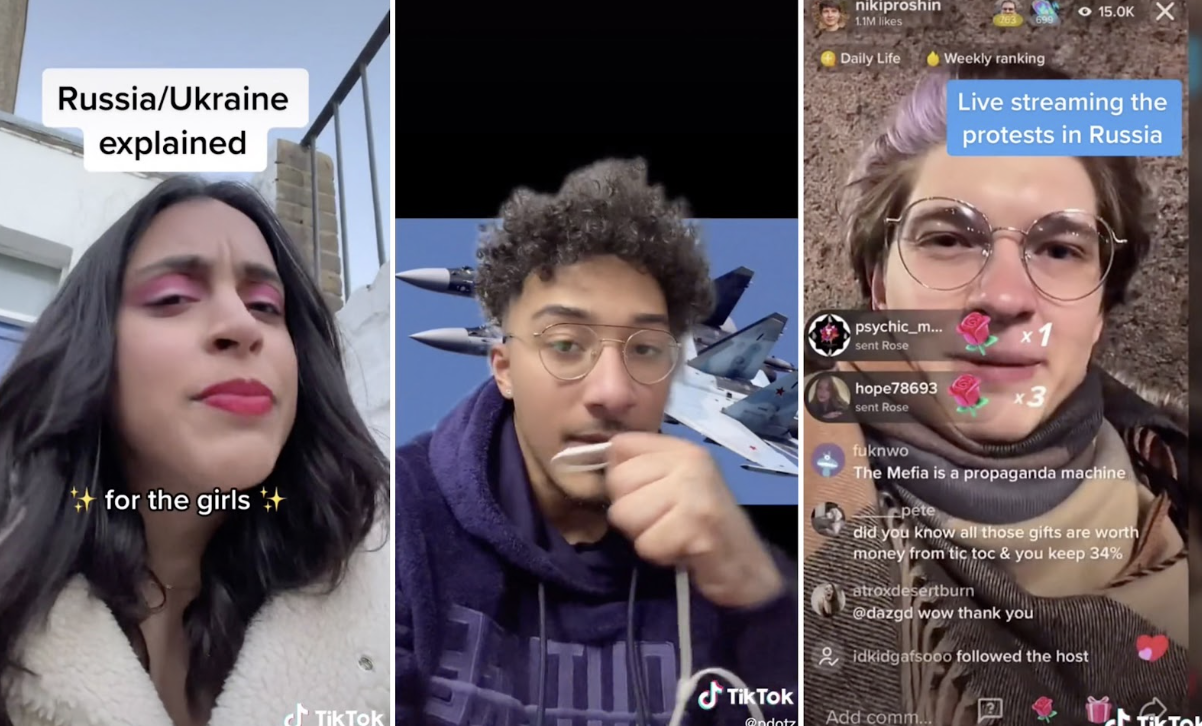
TikTok creators explaining and livestreaming the Russia–Ukraine conflict in early 2022. The vertical format, captions, and comment streams illustrate how war was mediated through platform-specific narrative styles. Source: The Guardian.
To understand how this digitally engineered closeness works, it helps to look at what young viewers were actually seeing — not abstract “social media,” but the specific narrative techniques that structured how viewers emotionally encountered the war — first-person POV footage that simulated intimacy, memetic humor layered over destruction, livestream fundraisers set to trending audio, and abrupt tonal shifts between tragedy and entertainment. During the invasion’s first weeks, ordinary Ukrainians on TikTok began acting as informal war correspondents. Media scholars Tom Divon and Moa Eriksson Krutök analyzed ninety-seven early-war TikTok videos and identified a distinct genre of “war influencers” — citizens who used platform-specific techniques to document daily life under attack. They note tactics such as point-of-view (POV) footage that simulates first-person experience, “memetic humor” juxtaposing destruction with trending sounds, and “playful politainment” like livestream fundraisers set to upbeat music. These creators, they argue, “leverage platform affordances and user interactions to amplify war zone visibility, foster civic engagement, and shape global perceptions” of the conflict (Divon and Krutök). A thirty-second bomb-shelter tour paired with a cheerful audio clip could emotionally hook viewers almost instantly. TikTok did not merely report on the war; it shaped the terms by which viewers encountered and interpreted it. Many young people felt that they were not just witnessing events but accompanying the people living through them.
Ukraine’s own information strategy intensified this feeling. As Magdalene Karalis writes in the Georgetown Journal of International Affairs, Ukrainian supporters deliberately cultivated parasocial bonds with global viewers, making “supporting Ukraine become supporting a friend” (Karalis). Emotional resonance was central: graphic footage from places like Bucha “appealed to Western leaders’ moral obligation” to respond (Karalis). The aim was not only to inform but to sustain global outrage and sympathy through intimate, human-centered storytelling. For young viewers far from the conflict, these posts transformed a distant geopolitical crisis into something painfully close. Many felt a sudden, urgent sense of “we have to do something” as their feeds filled with crying children, destroyed homes, and resilient humor.
This emotional closeness mattered. Developmental psychologist Diana Samek notes that adolescence is a formative period for moral development, making the real-time “mass devastation” visible on social media particularly impactful (Samek). American teens who had never encountered war suddenly saw destruction nightly on their phones. Samek explains that this constant exposure left many feeling simultaneously compelled to act and helpless. They felt it was no longer possible to ignore injustices “half a world away” when such images appeared between birthday posts and memes (Samek). Yet, they also did not know how to respond. Should they repost? Donate? Protest? The early months of the war created a generation of viewers who were intensely aware and emotionally invested, but uncertain how to translate that digital empathy into sustained civic engagement.
To understand why this emotional wave struggled to become action, it helps to turn to Walter Lippmann. Writing a century before TikTok, Lippmann argued in "Public Opinion" that people respond not to the world itself, but to the “pictures in their heads” — images shaped by media representations, not firsthand experience (Lippmann). In his era, these pictures came from newspapers and rumors; today, they come from algorithmic feeds. TikTok determines which clips appear on teenagers' screens, shaping which “pictures” become their understanding of the war. A viewer might unknowingly build an entire perception of the conflict from a handful of fifteen-second videos edited for maximum emotional impact. This curated environment is what Lippmann would call a “pseudo-environment,” a selective slice of reality that can easily be mistaken for the whole.
Media theorist Dennis Yi Tenen helps clarify how this pseudo-environment is produced. Tenen explains that contemporary digital systems “read greedily: all literature, all of the time,” ingesting and sorting massive amounts of material in order to automate what becomes visible to users (Tenen 2). He notes that this information includes “the messiness of human wisdom and emotion — the information and disinformation, fact and metaphor” (Tenen 2). This means TikTok’s algorithm digests unfiltered human expression — including contradictions and manipulations — before shaping what users see; the result is anything but neutral. Its ‘reading’ is selective, patterned, and partial. Read alongside Lippmann, Tenen makes clear that TikTok’s apparent immediacy is a product of automated mediation — a closeness that feels like knowledge even when it is partial and uneven.
Susan Sontag deepens this concern. In Regarding the Pain of Others, she argues that images of suffering can shock viewers, but shock “is not the same as understanding,” because distant observers “can’t understand, can’t imagine” the true horror they see on screen (Sontag 97-98). A TikTok of a crying mother in a bunker may provoke genuine empathy, but the next swipe leads to a prank video or ad. The abrupt shift in tone can turn tragedy into something consumable, encouraging brief flashes of outrage rather than the slower, more deliberate work of building sustained understanding. That gap between reaction and understanding becomes the place where civic response falters. Sontag warns that repeated exposure to violent imagery can generate desensitization — what she and others call compassion fatigue. In an endless scrolling environment designed to hold attention, even the most horrifying images lose force through repetition. TikTok’s structure can unintentionally dilute moral urgency even as it intensifies emotion at the expense of understanding.
This dynamic becomes even clearer when considering TikTok’s specific visual language. Early-war TikToks frequently juxtaposed scenes of destruction with TikTok’s fast edits, popular audio clips, and abrupt mood changes. A video might begin with shattered glass on a Kyiv street and then jump to a young creator dancing to a trending meme sound. These aesthetics compress time, mood, and even political histories into seconds. The result is immediacy without interpretive depth. A brief clip can inspire empathy, but it cannot provide the historical or ethical scaffolding that empathy must rest upon to become responsibility. Sontag’s warning about how repeated images can flatten suffering becomes unmistakable on TikTok; in fact, the platform’s form almost guarantees this effect.
This helps explain why early waves of online empathy proved difficult to sustain. Emotional engagement is immediate; civic responsibility is slow. One obstacle is the rise of symbolic or performative activism — what critics often call “slacktivism.” Media theorist Andrew Hoskins argues that the digital age has created a “loosening of the presumed relationship between media representation, knowledge, and response” (Hoskins). Abundant images of suffering no longer guarantee substantial action. He describes today’s online environment as filled with "algorithmically charged outrage,” where likes, shares, and comments create the illusion of collective actions without producing tangible political or humanitarian outcomes (Hoskins). In Ukraine’s case, many teens flooded feeds with #StandWithUkraine hashtags and screenshots of small donations — acts grounded in genuine feeling, albeit disconnected from deeper engagement.
The psychological stakes of this environment are high. Exposure to suffering can spark ethical attention, but that attention becomes unstable when the emotional weight exceeds a young viewer’s ability to make sense of it. Developmental psychologist Diana Samek notes that late adolescence is a formative period for ethical identity, which makes constant exposure to the “mass devastation” in Ukraine circulating on TikTok and Instagram especially destabilizing for teens (Samek). Many adolescents reported feeling a sudden responsibility to act, yet simultaneously feeling powerless, creating a tension between wanting to act and not knowing how. Without interpretive tools – historical context, media literacy skills, and clear pathways for channeling emotion into action – that intensity burns out quickly, turning initial engagement into withdrawal. Compassion fatigue is not merely theoretical here; it is an observable pattern among youth struggling to process the relentless stream of war content. This strain intensified precisely because the Ukraine War was the first major conflict to unfold directly on TikTok, where raw footage, memes, and eyewitness clips circulated within minutes, shaping young people’s perceptions long before traditional news outlets could.
Writer Cole Arthur Riley captures the personal pressure behind such gestures. Reflecting on early 2022, she explains that followers demanded she “say something about Ukraine,” even though she felt she had “nothing constructive to say” (Riley). She describes a culture in which people “perform our grief in the public arena,” not always to help, but to avoid being seen as indifferent. The dynamic echoes moments like Instagram’s Blackout Tuesday, when posting a black square became a public test of one’s morality, even though the gesture drowned out useful information. For many young people, the Ukraine war repeated this pattern: posting was perceived as necessary to demonstrate care, even when they lacked context or clarity. As Riley argues, public expressions of grief can become ways of absolving oneself rather than confronting the harder work of sustained action.
Another factor destabilizing digital empathy is misinformation. A 2025 study by Alexandra-Niculina Ghergut-Babi and colleagues found that Gen Z overwhelmingly relies on social media for news but often uses superficial cues — follower counts, video quality, or verified badges — to judge credibility (Ghergut-Babii et al.). This makes them vulnerable to propaganda and false narratives. During the Ukraine war, both accurate reporting and misleading content circulated widely, and many young viewers struggled to distinguish between them. Lippmann’s notion of the ‘pictures in their heads’ becomes newly urgent in an algorithmic environment where TikTok now supplies those pictures — deciding, long before the viewer does, which fragments of the war become thinkable in the first place. If the pictures are distorted, so is the civic reaction.
Algorithmic curation intensifies this vulnerability. Platforms feed users more of what they engage with, generating echo chambers that reinforce existing beliefs. A teen who clicks on pro-Ukraine posts may see only a narrow slice of the conflict without historical context or geopolitical nuance. Meanwhile, disinformation campaigns — especially those emphasizing Western hypocrisy or circulating out-of-context historical comparisons — blur moral clarity (Karalis). In such an ecosystem, emotional empathy is easily steered by what the feed elevates — patterns that privilege speed and affect over context. When the structure of the feed filters out nuance, fleeting emotional reactions struggle to develop into stable political understanding. These patterns reveal a crucial truth that digital empathy alone cannot yield civic responsibility. Emotional proximity cannot sustain civic life. Something else must intervene — something that helps young people interpret what they see, resist misinformation, and convert fleeing emotion into meaningful participation. That missing element is digital literacy.
The difference digital literacy makes becomes clearer when imagining two viewers encountering the same viral video — say, a Ukrainian teenager sprinting to a shelter during an air-raid siren. A viewer with low literacy may react with fear or sadness, repost it with a caption like “this is so horrible,” and move on. Their engagement is emotional, immediate, and fleeting. A digitally literate viewer, by contrast, slows down. They check the source, look for corroboration, verify the video’s date, and consider its context. They may consult reliable reporting or fact-checking sites. Crucially, they are more likely to take sustained action such as donating to vetted charities, contacting representatives, or joining event initiatives. Both viewers feel empathy; only one has the tools to transform it into accountable action. Digital literacy is not optional. It provides the structure that helps convert momentary emotion into accountable action. Indeed, Ghergut-Babii et al. find that low digital literacy correlates with reduced civic engagement, while higher literacy correlates with meaningful participation (Ghergut-Babii et al.). Digital literacy is what allows empathy to take the form of public obligation: it slows viewers down, deepens their understanding, and makes lasting civic involvement possible.
Political theorist Hannah Arendt offers a way of understanding why ongoing commitment matters. In “Collective Responsibility,” Arendt distinguishes between guilt and responsibility. A person may not cause a crisis, but by being part of a shared political world, they are responsible for how they respond to it. Responsibility, she writes, arises from “membership in a group,” not from personal blame (Arendt). Arendt’s framework shows why the Ukraine War felt morally pressing to young viewers: images of suffering, even when mediated by a screen, generate a sense of shared implication. Yet Arendt also insists that responsibility requires thought and action, not mere appearance. A repost may signal feeling, but responsibility requires something more durable: sustained attention, informed judgment, and concrete response.
Taken together, Lippman, Sontag, and Arendt illuminate the central tension of digital-age civic life. TikTok collapses distance, making faraway events feel close. That closeness can awaken empathy. Though without literacy and reflection, empathy stays fragile — easily swayed by algorithms, easily exhausted by repetition, easily replaced by performance. What appears to be civic engagement risks becoming only a feeling of engagement.
The story of Ukraine on TikTok shows both the promise and limitations of digital witnessing. Short-form video can mobilize global audiences faster than any medium before it. It can humanize distant suffering and inspire real solidarity. Nevertheless, it can also overwhelm, mislead, or distract, preventing emotional response from developing into responsible action. The challenge is not whether young people care — clearly they do — but whether they can transform caring into citizenship.
Digital empathy from TikTok’s Ukraine coverage can spark civic feeling, but that feeling is fragile. Emotional intensity rarely becomes civic responsibility. Only when youth develop digital literacy and sustained interpretive habits does online attention transform into genuine civic engagement. The task ahead is to build an ecosystem — educational, technological, and cultural — where fleeing awareness can mature into durable responsibility. If that happens, the viral images that once flooded their screens may become more than an endpoint of feeling, but the beginning of a sustained and thoughtful relationship to civic life.
Reference List
Arendt, Hannah. “Collective Responsibility.” Responsibility and Judgment, edited by Jerome Kohn, Schocken Books, 2003, pp. 147-58.
Tenen, Dennis Yi. “Intelligence as Metaphor (An Introduction).” Literary Theory for Robots: How Computers Learned to Write, W. W. Norton & Company, pp. 1-14
Divon, Tom, and Moa Eriksson Krutrök. “The Rise of War Influencers: Creators, Platforms, and the Visibility of Conflict Zones.” Platforms & Society, vol. 2, no. 1, 2025, https://doi.org/10.55225/platformsandsociety.102.
Gherguț-Babii, Alexandra-Niculina, et al. “Challenges for NGO Communication Practitioners in the Disinformation Era: A Qualitative Study Exploring Generation Z’s Perception of Civic Engagement and Their Vulnerability to Online Fake News.” Journalism and Media, vol. 6, no. 3, 2025, pp. 1-20. MDPI, https://doi.org/10.3390/journalmedia6030136.
Hoskins, Andrew. “Media and Compassion After Digital War: Why Digital Media Haven’t Transformed Responses to Human Suffering in Contemporary Conflict.” International Review of the Red Cross, vol. 102, no. 913, 2021, pp. 117-43, https://international-review.icrc.org/articles/media-compassion-digital-war-human-suffering-contemporary-conflict-913.
Karalis, Magdalene. “The Information War: Russia-Ukraine Conflict Through the Eyes of Social Media.” Georgetown Journal of International Affairs, 2 Feb. 2024, https://gjia.georgetown.edu/2024/02/02/russia-ukraine-through-the-eyes-of-social-media/.
Lippmann, Walter. Public Opinion. 1922. Project Gutenberg, 2004, https://www.gutenberg.org/ebooks/6456.
Rawlinson, Kevin. “The First TikTok War: How Russia and Ukraine Are Using the Platform.” The Guardian, 26 Feb. 2022, https://www.theguardian.com/media/2022/feb/26/social-media-influencers-russia-ukraine-tiktok-instagram.
Riley, Cole Arthur. “You Don’t Need to Post About Every Tragedy.” The Atlantic, 28 Mar. 2022, https://www.theatlantic.com/family/archive/2022/03/social-media-activism-ukraine-solidarity/629402/.
Samek, Diana. “Youth Development Researcher: Russia-Ukraine War Impacting Emotional, Mental Health of American Youth.” Auburn University Office of Communications & Marketing, 4 Apr. 2022, http://ocm.auburn.edu/newsroom/news_articles/2022/04/041422-samek-ukraine-youth.php.
Sontag, Susan. Regarding the Pain of Others. Farrar, Straus and Giroux, 2003.