
On Accessing the Right to Vote
By Emelin Brito, Trisha Liu, Anika Hadap
The United States of America was founded on the principle that the people would hold the power. Our nation’s founding fathers have made their support for this clear through documents such as the Declaration of Independence, The Federalist Papers, and the Constitution. Exercising our right to vote, a right many fought to obtain, is a form of exercising our power as citizens and upholding our democracy. However, there are several Americans who have historically been disenfranchised due to race, socioeconomic status, gender, and other discriminatory factors. Although most of the laws that allowed exclusion are no longer instated, the effects of those laws continue to affect our most vulnerable populations today.
Voter turnout across the United States is extremely low by international standards. Even in major elections like the presidential, just 60 to 65% of eligible individuals voted, and in congressional midterms, just 40%.
For decades, inequality has affected voter turnout, with the wealthy more likely to vote than the working class. There are many reasons associated with this, including the time and monetary cost associated with voting. The cost of public transportation, lines at polling stations, and the time it takes to find voting information are more difficult for working-class citizens working long hours than for the upper and upper-middle class, who have more flexible hours. For example, minimum wage workers who have to take time off work to vote will have a higher opportunity cost than those with a stable, high-paying salary, making them less likely to turnout. Complex voting laws regarding registration, identification, early voting, and mail-in voting also contribute to higher opportunity costs and likely affect turnout.
Education level also plays a significant role in voter turnout. 77% of eligible voters who have an undergraduate degree voted, and 90% of eligible voters who completed their post-graduate degree voted, compared to just 54% of those with high school diplomas and 36% of dropouts. Education provides not only a greater ability to understand and consume political information, but also a greater societal and historical context for politics.
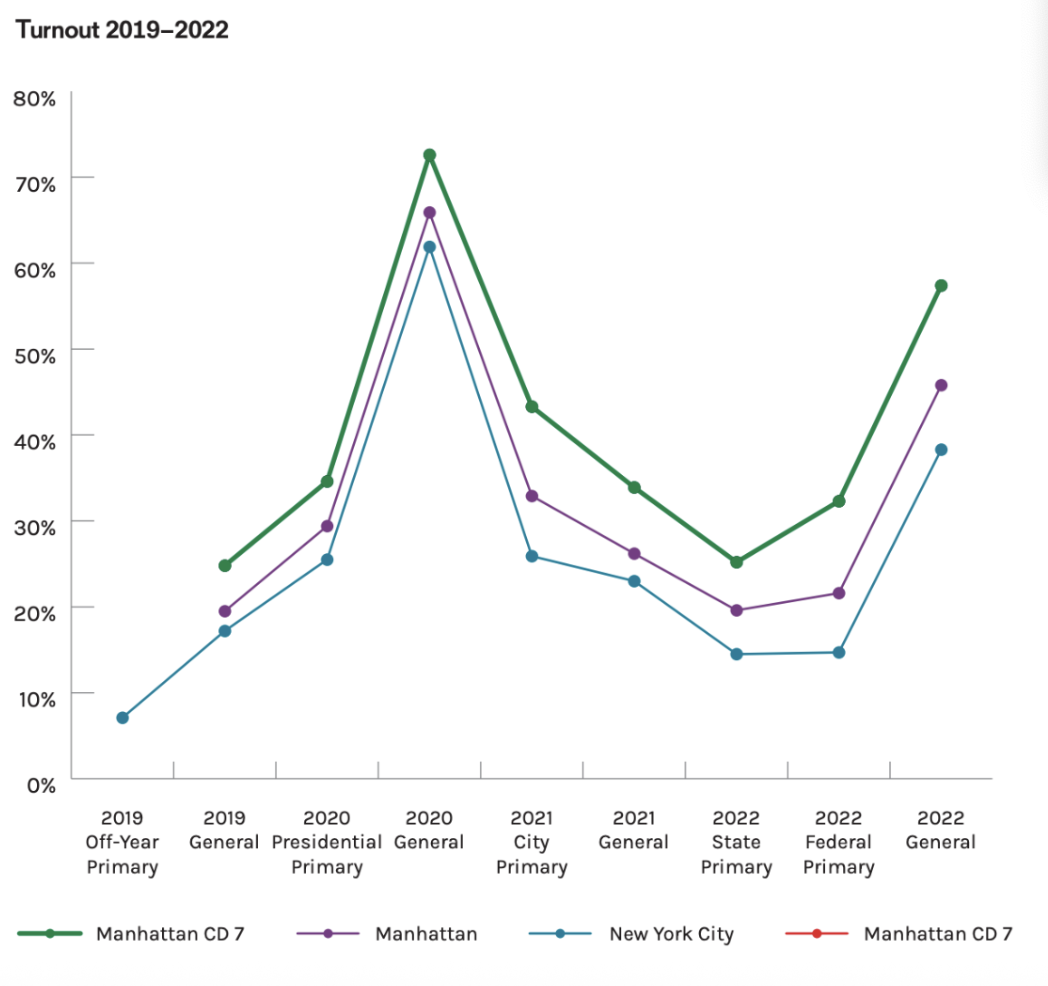
Many cities across the United States have seen these trends, with wealthy, educated neighborhoods having significantly higher turnout rates than the city as a whole. Manhattan’s District 7 highlights a combination of how both high education levels and high-income factor into an increased voter turnout. This district, which contains the Upper West Side, Manhattan Valley, and Lincoln Square, is one of the most educated, with 94.6% of eligible voters having graduated from high school or above, compared to just 83.2% across New York City. The district also has a significantly higher percentage of voters who obtained a Bachelor's or Master’s Degree, at ~75% compared to the New York City average of ~38%. Similarly, household income is significantly higher than New York City overall, with families having an annual income of $136,549 compared to a median of $70,663 across the city. In conjunction with higher levels of education and greater wealth, Manhattan District 7 had a higher turnout in every election between 2019 and 2022 compared to New York City as a whole. For example, over 55% of eligible voters in Manhattan CD 7 voted in comparison to ~35% in New York City overall in the 2022 general election. A major barrier to voter access in New York City has been distrust of voting systems and election processes. This seems counterintuitive, as elections are a major source of the consent of the governed and provide a way for voters to trust the goings-on of their governments, given the direct role of voters in their operations. However, certain groups of New York City voters feel alienated from election systems and processes. This can be attributed both to the rhetoric surrounding the efficacy of voting as well as the structure of New York City elections itself.
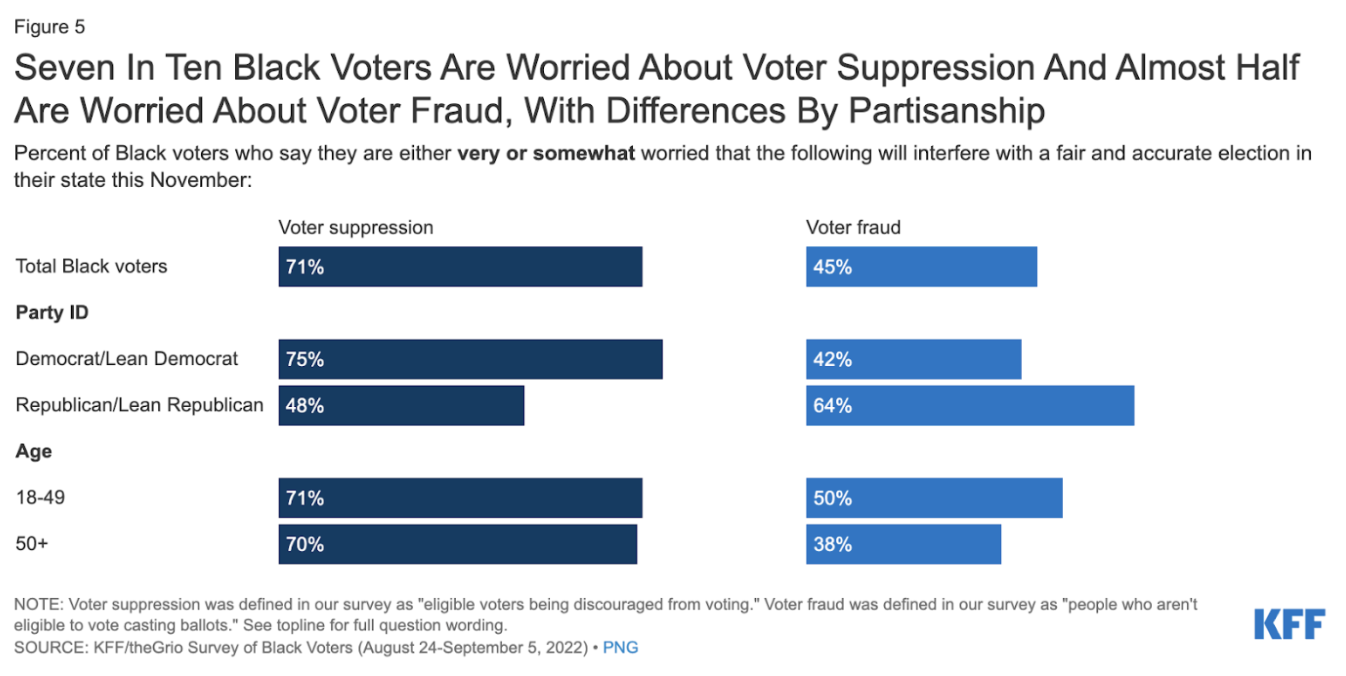
GoVoteNYC finds that in New York City, Black and Latinx communities feel especially alienated from elections. This is because of the widespread rhetoric among these communities that voting will not make a difference in improving their standing in both the city and the nation. After all, Black and Latinx communities have been historically and presently targeted by governments at all levels. As a result, these communities rightfully lack trust in those who govern them, making it difficult to emphasize the importance of voting. A study from 2022, during a midterm election year, showed that 7 in 10 Black voters feared voter suppression, or discouragement from voting. Fear of suppression often deters people from voting. A 2024 study interviewed 88 Black voters about their electoral participation and found that 61% of interviewees felt that their vote didn’t matter. These statistics show a deep skepticism regarding the impact of voting and ultimately contributes to what GoVoteNYC calls “election fatigue”, a major reason for low voter turnout.
In New York City specifically, there is a high population of immigrants. According to the 2020 census, 40% of New York City’s populous are immigrants, not including undocumented immigrants. This has created an interesting dynamic between these people and the democratic processes of America. Immigrants don’t always come from democratic institutions. Given their experiences with the political institutions of their country of origin, they will compare American institutions to those of their home country. People newly encountering democracy are not always inclined to trust it. A 2021 report from Political Studies finds that it takes time for immigrants to develop trust in new political institutions; that trust does not exist from the moment of their arrival.
So, how can we go about mitigating these issues and potentially solving them? In addressing the disparity between the number of low-income voters and wealthy voters, we need to tackle these issues directly. In a survey conducted in 2018, 28.43% of participants cited “work/school obligations” as the primary reason for not voting. While the logical solution seems to request an absentee ballot, 12.39% of participants reported they were unable to obtain one in part because they did not qualify. It wasn't until the passing of the New York Early Mail Voter Act, which took effect on January 1, 2024, that voters could request an early mail or absentee ballot. A person who is of low income is less likely to take off work to vote, especially on a Tuesday, as most jobs that pay by the hour do not give the day off to their workers. Rather than forcing voters to choose between their job and education or their country, we should change the way we operate.
In a video by TED-Ed, the speaker states, “'In 1845, Tuesday was the most convenient day…It could take a day or longer for farmers to get to the county seat to vote, and Tuesday allowed them this time without interfering with the Sabbath or Wednesday, which was market day.” Undoubtedly, much has changed since the 19th century. For example, due to the increase in polling places since the 1840s, as well as the invention of cars and buses, it no longer takes days to travel to a polling site. With the increase in diversity of religion in the United States, it is no longer most convenient for the government to host the elections on Tuesday. Considering that schools and universities don’t typically have classes on the weekends, this would also allow eligible high schoolers and college students to participate in voting as well. Along with this, 70.57% of people surveyed by the New York State Senate Democratic Policy Group said they would be more likely to vote if elections were held on weekends. So, other than tradition, why do we keep hosting elections on a Tuesday? It seems as though it would be most effective to move election day to the weekend in order to increase voter turn out.
Higher education isn’t accessible to many due to familial obligations, cost, time, or additional responsibilities. Our job and that of our leaders is to meet people where they are. A lack of education is often directly tied to being of a lower income, so the courses of action previously mentioned would help aid this issue; however, we can do more. Making a continuous decision to listen to the people gives them the opportunity to feel heard. Acknowledging and addressing power imbalances while concentrating efforts to distribute information in lower-income communities is a great step we as students can take in connecting with lower income communities and creating opportunities to help educate the city.
Given the diversity of experiences people may have with our government, it’s easy to see why many have distrust in our electoral processes. This sentiment is magnified amongst those who come from authoritarian or fascist regimes. Black communities in the United States have a history of being persecuted in the U.S., specifically through the electoral college. While simple, yet commonly overlooked, our leaders and politicians must lead with honesty, compassion, and curiosity. Diversity is part of what makes New York such a great place to live. However, it is because of this that our leaders should look to be curious and connect with the diaspora of people, showing appreciation for the variety of cultures. If leaders are open and show genuine interest in the communities of which they seek to represent, hopefully more people will feel that their voices are worth being heard. In authoritarian regimes, leaders seek to distance themselves from the general population, making themselves out to be a God-like figure that is inaccessible to the people. Voters who have lived through that kind of government have every reason to have lost faith in governmental processes, so it is the job of our leaders to work to restore it through compassion for their past difficulties.
Rule of law, the equal application of the law to all, is key in regaining the trust of all Americans, especially that of marginalized communities such as Black and Latine communities. Currently, U.S. President Donald Trump, is a felon found liable in a civil court on 34 counts, yet he was allowed to remain in office. This seems to be directly at odds with the fact that the 13 states do not permit felons to vote. Despite allowing felons the right to vote in New York, other states do not, so we should acknowledge that "injustice anywhere is a threat to justice everywhere.” Dr. Martin Luther King Jr. wrote that phrase in his letter from a Birmingham Jail, pointing out that “whatever affects one directly, affects all indirectly.” This ties directly to the fact that even though felons in New York can vote, we should not accept this inconsistency in the law, especially on such a fundamental right as the right to vote. This inconsistency affects how voters perceive the integrity of the U.S. If we set an example by holding our politicians accountable will help in showing that the U.S. is fair and just for all, not just those who can afford bail.
Increasing voter turnout across the board isn't easy. Many of our predecessors have fought to help pass fundamental legislation that makes the work we do now possible. As time continues to pass, our duty to ensure every voter has the chance to express their political beliefs through their ballot increases ever more.